
How to Respond to IRS CP59 Notice
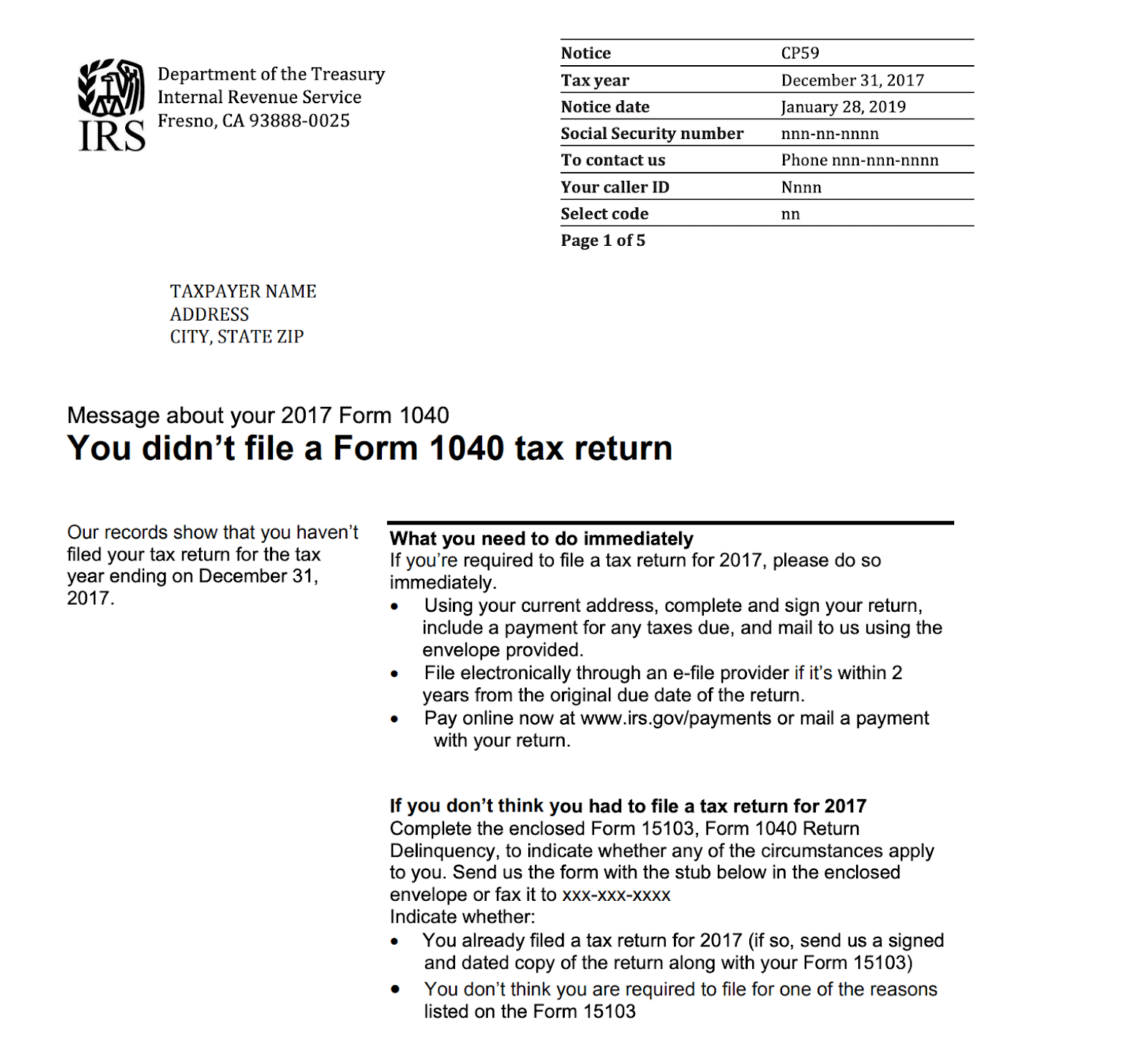
If you’ve been neglecting your obligation to file your U.S. tax returns, you will likely receive an IRS CP59 notice. Receiving the letter requires urgent action. You either file your tax return or explain to them why don’t need to file.
You must take the necessary steps or face penalties for not filing. The penalty starts at 5% of the unpaid tax each month your tax return is overdue and up to 25%.
What an IRS CP59 Notice Means
A CP59 notice is the IRS’s request for a missing individual income tax return. The notice identifies the tax year in question and explains how to respond. It may also include Form 15103, Form 1040 Return Delinquency, which allows you to state whether you filed the return or why you believe you did not have to file.
Read every page carefully and compare the tax year on the notice with your own records. Do not assume the IRS is correct, but do not set the letter aside. A delayed response can lead to additional notices, penalties, an IRS-prepared return, or collection action.
Why Expats May Receive a CP59 Notice
U.S. citizens and resident aliens generally remain subject to U.S. tax filing rules while living abroad. Some expats mistakenly believe that living outside the United States, paying foreign taxes, or qualifying for the foreign earned income exclusion automatically removes the filing requirement. In many cases, those benefits must be claimed on a timely and accurate U.S. return.
Other taxpayers become non-filers after a major life event, missing records, financial hardship, illness, business problems, or several years of falling behind. Once one return is missed, the next year can feel harder to address. The problem usually becomes more stressful the longer it remains unresolved.
A non-filer is a taxpayer who did not meet a federal or state filing obligation by the original due date or an approved extension date. Not everyone who receives a CP59 notice is truly a non-filer, however. The IRS may not have processed a return, may have received it under incorrect information, or may lack records showing that no filing requirement applied.
What to Do After Receiving a CP59 Notice
Start with the response deadline and the tax year listed on the notice. Then determine which of the following situations applies to you:
- You were required to file and have not filed the return.
- You already filed the return, but the IRS has no record of it.
- You were not required to file for the year shown.
If the return is missing, prepare and file it as soon as possible. Include all required schedules and international information returns that apply to your situation. If tax is due, you may pay with the return or use an available IRS payment method. Filing the return remains important even when you cannot pay the full balance immediately.
Follow the mailing, fax, or online response instructions printed on the notice. Keep a complete copy of everything you submit, along with proof of mailing or electronic filing.
What If You Already Filed the Return?
If you filed the return, respond with the information requested in the notice. This may include a signed and dated copy of the return and a completed Form 15103. Include proof of filing when available, such as an electronic filing acceptance, certified mail receipt, private delivery confirmation, or other documentation showing when and where the return was sent.
Do not automatically file a second original return without reviewing the circumstances. A duplicate filing can create processing delays or account confusion. A tax professional can review the IRS account transcript to determine whether the first return was received, rejected, posted incorrectly, or is still being processed.
What If You Were Not Required to File?
If you believe you did not have a filing requirement, complete the response form included with the notice and explain why. Your explanation should match the facts for that tax year, including your filing status, age, gross income, self-employment income, and any special filing rules that applied.
Expats should be cautious before concluding that no return was required. Income excluded under the foreign earned income exclusion is generally reported on a filed return, and foreign financial reporting rules may apply separately from the income tax return. When the filing position is uncertain, get advice before sending the response.
How to Gather Missing Tax Records
Do not let missing documents stop you from addressing the notice. Start by collecting wage statements, contractor income forms, bank records, brokerage statements, pension information, foreign tax records, business records, and prior-year returns.
You may also request IRS wage and income transcripts or account transcripts. These records can help identify U.S.-reported income, payments, prior filings, and IRS activity. They may not show all foreign income or foreign financial accounts, so you may still need records from overseas employers, banks, investment providers, and tax authorities.
For several years of missing returns, it is generally best to organize the documents by year before preparing anything. This reduces the chance of reporting income in the wrong period or overlooking forms that repeat annually.
Penalties and Other Risks for Non-Filers
The failure-to-file penalty generally starts at 5% of the unpaid tax for each month or part of a month the return is late, up to 25%. Other penalties and interest may also apply. The actual amount depends on the facts, the balance due, and how late the return is filed.
Ignoring a CP59 notice may lead to more correspondence and stronger enforcement. Depending on the case, the IRS may propose tax, begin collection activity, file a federal tax lien, issue a levy, or refer a willful case for further investigation. Most non-filers are not criminal cases, but continuing to ignore repeated IRS contact increases the risk and limits your options.
Late international information returns may carry separate penalties. These rules can be especially serious for expats with foreign corporations, partnerships, trusts, gifts, pensions, or financial accounts. Filing a basic Form 1040 without reviewing the related international forms may not fully resolve the problem.
How a Substitute for Return Can Affect You
If you do not file, the IRS may prepare a Substitute for Return, often called an SFR, using information reported by employers, banks, and other third parties. The IRS does not prepare the return to obtain the best result for you. The SFR may use a less favorable filing status and may leave out dependents, itemized deductions, business expenses, credits, foreign tax benefits, and other items that could reduce the tax.
An SFR can therefore produce a much higher proposed balance than a properly prepared return. It also does not usually end your filing responsibility. You may still need to prepare and submit your own return so the IRS can determine the correct tax.
After an SFR, the IRS may issue a Notice of Deficiency showing the proposed assessment. The notice usually provides a limited period to challenge the determination in U.S. Tax Court. Missing that deadline can allow the IRS to assess the tax and move toward collection.
Statute of Limitations for Unfiled Returns
For a properly filed federal income tax return, the IRS generally has three years to assess additional tax, although longer periods may apply in certain cases. When a required return is never filed, the normal assessment period generally does not begin.
An IRS-prepared Substitute for Return does not normally start the same limitations period as a return filed by the taxpayer. This is another reason to prepare and file an accurate return rather than leaving an SFR unresolved.
Refund claims also have deadlines. A taxpayer who waits too long to file a past-due return may lose a refund even when tax was withheld or estimated payments were made. Filing sooner can protect information, options, and potential refunds.
Other Reasons to File Past-Due Returns
Getting caught up does more than stop IRS notices. Filed returns may be needed when you:
- Apply for a mortgage, loan modification, or other financing.
- Request college financial aid or provide income verification.
- Consider bankruptcy or seek treatment of tax debt in bankruptcy.
- Apply for immigration, residency, or citizenship benefits that require tax records.
- Need accurate Social Security earnings records or proof of self-employment income.
Filing also helps you establish a clear record of your income, deductions, credits, and foreign tax positions for each year.
How Expat Non-Filers Can Get Back Into Compliance
The right approach depends on how many years are missing, whether the IRS has contacted you, whether tax is due, and whether foreign reporting forms were omitted. A good starting process is:
- Confirm which federal and state returns are missing.
- Obtain IRS transcripts and gather U.S. and foreign records.
- Identify all income tax and international reporting forms required for each year.
- Prepare accurate returns before responding or filing.
- Review available penalty relief and payment options.
- Submit the response and returns using a trackable method.
- Stay current with all future filing and payment obligations.
Some eligible taxpayers living abroad may qualify for an IRS compliance procedure designed for non-willful failures, such as the Streamlined Foreign Offshore Procedures. This is not the right option for everyone. The facts, filing history, source of the noncompliance, and prior IRS contact should be reviewed before choosing a submission method.
A tax balance is not a reason to remain unfiled. The IRS offers collection options that may include installment agreements, offers in compromise, and temporary hardship status. These options generally become easier to evaluate after the required returns have been filed.
When to Get Professional Help
Consider working with a qualified tax professional when several years are missing, the IRS has prepared an SFR, collection activity has started, records are incomplete, foreign assets or businesses are involved, or you are unsure whether your failure was non-willful.
An experienced expat tax professional can review IRS transcripts, identify missing forms, prepare the returns, explain available compliance options, and communicate with the IRS when representation is needed. This can reduce mistakes and help you respond with a coordinated plan rather than sending incomplete information one item at a time.
Advice from Tax Experts
Receiving a CP59 notice is stressful, but ignoring it usually makes the situation worse. Respond by the deadline, file any required return, and keep proof of what you submitted. If you have not received a notice yet but know you have unfiled returns, acting voluntarily may provide more options than waiting for the IRS to contact you.
Tax Samaritan’s Enrolled Agents and CPAs help U.S. taxpayers abroad resolve unfiled returns, IRS notices, and related international reporting issues. Contact our team to discuss the missing years and the best path toward compliance.
Click the button below to request a free 30-minute, no-obligation consultation meeting.
Every effort has been made to provide accurate and current tax information. This article is not a substitute for professional tax advice based on your individual circumstances. Tax law changes frequently. Please consult a qualified tax professional before making decisions based on this content.

