
IRS Form 843 Instructions: Abatement & Refund for Expats
Randall Brody, Enrolled Agent | Licensed by the U.S. Department of the Treasury | Last Reviewed: July 2026
Key Takeaways
- IRS Form 843 allows taxpayers to request refunds for penalties, interest, or abatement due to IRS errors.
- Eligible filers include individuals, small business owners, estates, and trusts, with specific documentation required for decedents.
- Reasonable causes for abatement can include disasters, serious illness, or technical issues hindering filing.
- Filing IRS Form 843 involves multiple steps, including providing accurate details on the tax period and amounts.
- Supporting documents should include IRS notices, proof of timely filing, and evidence for reasonable cause.
Mistakes happen, even with the IRS. If you’ve been wrongly hit with a penalty or interest, IRS Form 843 can offer relief. As a U.S. expat dealing with more complex and potentially higher taxes, knowing how and when to use this IRS tax form could save you thousands of dollars.
What is IRS Form 843 Used For?
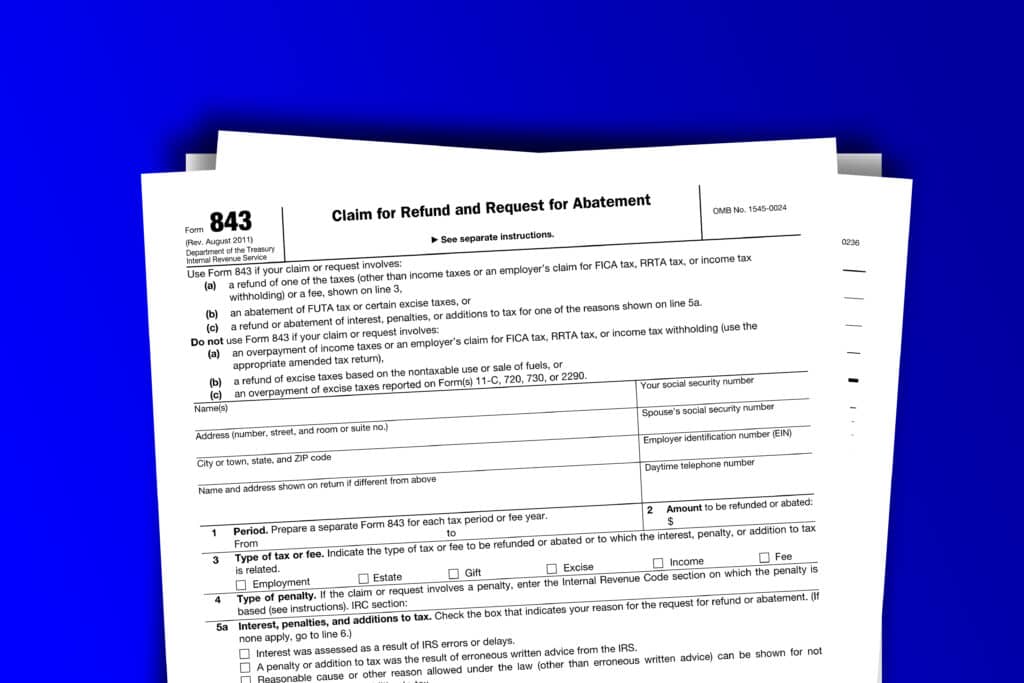
Form 843 is used to request abatement or refunds of certain penalties, interest, fees, additions to tax, and certain non-income taxes. It is not used to correct an income tax return, claim a standard income tax refund, or request relief when the IRS requires a different form.
You can file Form 843 to:
- Request a refund of penalties or interest assessed by error.
- Ask for abatement of penalties if you qualify for relief (like first-time abatement or reasonable cause).
- Claim a refund due to IRS error, such as wrong advice or misapplied payments.
- Recover excess Social Security or Medicare taxes that were wrongly withheld from your pay.
Note that Form 843 does not apply to regular income tax refunds. If you simply overpaid your taxes or forgot to claim a deduction or credit, you’ll need to file Form 1040-X to amend your return and request a refund.
What penalties or interest can be abated using Form 843?
Form 843 works best when you’re trying to remove IRS penalties like:
- Failure to file
- Failure to pay
- Failure to deposit employment taxes
- Erroneous trust fund recovery penalties
- Interest caused by IRS errors or delays
You can’t use Form 843 to remove interest that accrued simply because you didn’t pay your tax on time. But if the interest was due to IRS mistakes, such as processing delays or incorrect notices, you can request an interest abatement.
The form also works for requesting refunds of certain employment taxes or gift tax penalties, depending on the situation.
Different procedures may apply when the assessment involves FBAR and FATCA penalties, so confirm that Form 843 is the appropriate remedy before filing.
Who can file Form?
Anyone who’s received an unfair IRS penalty notice or paid a penalty can file. That includes:
- Individuals
- Small business owners
- Estates and trusts
If you’re living abroad and received a penalty for missing a filing deadline, but you had reasonable cause, you can file the Form 843 to request penalty abatement.
You can file the form yourself, or you can have an authorized representative do it for you.
If someone files on your behalf, they’ll need to attach Form 2848 (Power of Attorney) showing that you’ve permitted them to act for you on this specific request. Make sure you’ve signed Form 2848 and that it includes authorization for penalty and refund matters.
If you’re filing on behalf of a deceased taxpayer, the rules are different.
- If you filed the return and are still acting as the decedent’s representative, include a statement confirming your role.
- If not, you’ll need to attach certified copies of letters testamentary or administration to prove your authority.
- And if you’re claiming a refund for the decedent, include Form 1310 along with Form 843.
For estates and trusts, the form must be signed by the fiduciary, usually the trustee or executor.
What counts as reasonable cause when requesting penalty abatement with Form 843?
Reasonable cause means you made every effort to follow the rules, but something outside your control got in the way. The IRS reviews each request individually, so your explanation needs to show that you acted in good faith and took reasonable steps to comply.
Here are some situations that may qualify:
- A natural disaster, fire, or civil disturbance disrupted your ability to file or pay
- You or an immediate family member was seriously ill, passed away, or was unavoidably absent
- Technical issues prevented you from submitting your return or payment on time
- You made a good-faith effort to get your records, but couldn’t access them
- You faced a complex tax situation and genuinely tried to understand the requirements
The IRS usually won’t accept excuses like “I didn’t know,” “my tax preparer messed up,” or “I didn’t have the money.” Lack of funds or relying on someone else isn’t enough unless there are other facts showing you still tried to comply.
To support your request, include a clear, honest, reasonable cause letter with your Form 843. Explain to the IRS what happened, when it happened, and what you did to try to stay compliant. The more specific you are, the better your chances of getting that penalty wiped out.
Form 843 Instructions — How to Fill It Out
To complete Form 843, you enter the tax period, the type of tax or fee, the dollar amount, and the specific reason for your claim, then attach a written explanation and supporting documentation. Follow with a short line-by-line walkthrough of the key fields and the reasonable-cause explanation, since that explanation is what determines whether the IRS grants relief.
1) Top Section – Check the right box
At the top of the form, choose the reason you’re filing. This includes things like penalty abatement, interest due to IRS error, or excess Social Security tax. Only check one box. If your reason doesn’t fit any listed category, check “Other” and describe your situation.
2) Name and ID Info
Enter your full name, SSN or ITIN, and mailing address. If it’s related to a joint return, include your spouse’s name and SSN too. If you’ve moved recently, file Form 8822 to update your address with the IRS.
3) Line 1 – Tax period
Enter the start and end dates of the tax year or quarter tied to your request. If you’re filing for more than one year, use a separate Form 843 for each.
4) Line 2 – Amount to be refunded or abated
Enter the dollar amount you’re requesting back or asking the IRS to cancel.
5) Line 3 – Date(s) of payment
If you already paid the penalty or interest, list the exact date(s). Use a separate sheet if needed.
6) Line 4 – Type of tax
Check the box for the type of tax involved. Most expats will use “Income” or “Civil penalty.”
7) Line 5 – Type of return
Check the box for the form the issue is related to, like 1040 or 1120. If it’s not listed, use “Other.”
8) Line 6 – IRC code section
If this involves a penalty, enter the section of the tax code shown on your IRS notice (for example, 6651 or 6038).
9) Line 7 – Why you’re filing
Check the box that best describes your reason. It could be interest from an IRS error, bad advice, or reasonable cause. If none apply, choose “None of the above.”
10) Line 8 – Explanation
This is where you tell your story. Explain what happened, why the penalty or interest should be removed, and how you calculated the amount. Attach your reasonable cause letter and any documents that support your request.
11) Signature
Don’t forget to sign and date the form. If it’s for a joint return, both spouses must sign. Estates, trusts, and corporations must have the fiduciary or officer sign with the title included.
If you’re working with a tax professional, they’ll need to sign as a paid preparer and include their details.
Double-check everything before mailing. Missing or incorrect information can delay your refund or cause your request to be denied.
Where to Mail Form 843
The correct mailing address depends on why you are filing. If you are responding to an IRS notice, mail Form 843 to the address printed on that notice; otherwise, use the service center address listed in the current IRS Form 843 instructions for your situation. Mailing the form to the wrong address may delay IRS processing, so confirm the correct destination before sending it.
How long do you have to file Form 843?
You must file Form 843 within 2 years of paying the penalty or within 3 years of filing the related tax return, whichever is later.
If you miss the deadline, the IRS will reject your claim, even if your request is valid.
So don’t wait. File as soon as you realize the IRS may have made a mistake, or as soon as you qualify for penalty relief.
What supporting documents should you include with Form 843?
The more evidence you give the IRS, the stronger your case.
Your supporting documents may include:
- IRS notices showing the penalty or interest assessed
- Proof of timely filing, like certified mail receipts
- Explanation letters showing reasonable cause
- Evidence of overseas complications, like embassy letters, hospital records, or airline delays
You must attach everything to one packet. Missing supporting documents are a common reason why Form 843 gets denied or delayed.
Using Form 843 for First-Time Penalty Abatement
First-time abatement is often granted administratively — by phone or in response to a notice — without Form 843, while Form 843 is typically used to request abatement based on reasonable cause or to claim a refund of a penalty already paid.
Form 843 vs. Form 1040-X — Which Should You Use?
Use Form 1040-X to correct your income tax return or claim an income tax refund, and Form 843 for abatement or refund of penalties, interest, and certain non-income taxes.
What Form 843 Can and Cannot Be Used For
Form 843 covers refunds and abatement of certain taxes other than income tax, plus penalties, interest, fees, and additions to tax — but not income tax refunds and not situations where a different form is required.
Frequently Asked Questions
Should you file Form 843 on your own?
If you have a simple situation and you’re confident in explaining your case, you can fill out IRS Form 843 yourself. Just be sure to follow the IRS Form 843 instructions carefully and include supporting documents.
But if you’re unsure whether you qualify or if you want to avoid dealing with the IRS, working with a tax professional can save you time, stress, and potentially thousands in penalties.
For broader help with IRS debt, penalties, or notices, our tax resolution services can help you explore your options and work toward a solution.
Want expert help?
Click the button below to book a FREE, 30-minute, no-obligation consultation with our tax expert at Tax Samaritan.

